Do you ever walk out of a three-hour lecture feeling like you didn’t really learn much? Have you noticed yourself forgetting everything from a class over the summer? Do you wish you could retain more of what you’re taught? Well, if you’ve never heard of The Learning Pyramid, I have some tips for you!

Before I begin, I want to address the controversy regarding this concept.
As The Washington Post discussed, The Learning Pyramid is an oversimplification. Basically, some of the things that are said to be inefficient can be improved with small changes to how they are done. Plus, the way retention is measured can really alter the results. The idea here is that The Learning Pyramid is more of a way to think about learning and improve your retention. It’s not a specific collection of hard facts that are true for everyone.
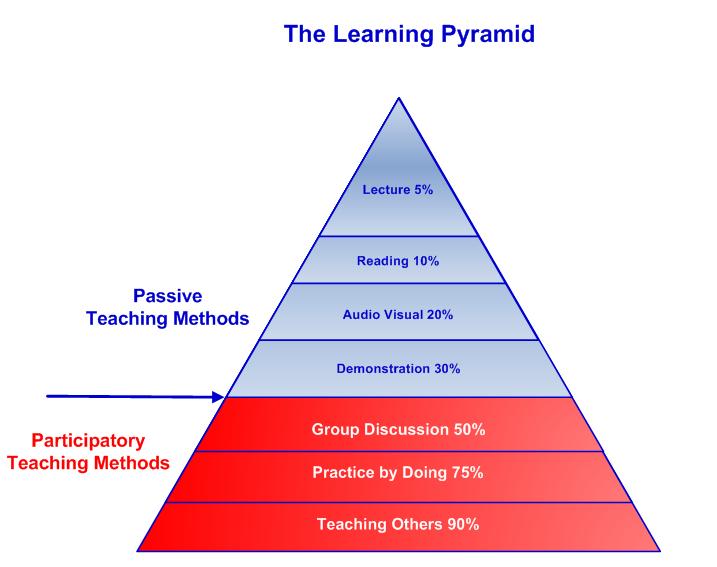
With that out of the way, there’s a lot of value here considering The Learning Pyramid’s retention percentages. The basic concept of the pyramid is that the more active you are, the more you learn. If you are passively listening to a lecture or reading, that won’t provide the same results as something more active like a group discussion. Want more clarification on the difference? Check out Active Participant vs Passive Observer.
We’ve all had that mental zombie feeling halfway through a long class… or right at the start of it, depending on your night before.

You all know what I mean. You’re hearing the words but you’re not actually listening. The information is not being received or it’s received but not stored anywhere. This is a big problem come exam time when you realize you basically have to learn the whole course in one night. So, take a tip from The Learning Pyramid and be more active!
Here are some ways to keep your mind active so you can retain more:
Listening to a Lecture?
Take notes. The act of sifting through the information and deciding what is important will help you remember the material. Plus, you won’t have to beg anyone for notes!
Doing a Reading?
Take notes. Ok, I know this is the same tip, but it works. If you just read something, you’re not really engaging with it. But if you take the time to analyze and decide what is important and summarize that in your own words, you’re thinking about what you’re learning. You’re now absorbing the information.
You could also read with a friend and take turns summarizing the important parts for each other. By teaching one another, you’ll be more engaged and active in your information collection. This should boost your retention considerably. Just make sure you pick a good partner!
Watching a Video in Class?
How would you communicate the takeaways to someone else? Is the video doing a good job? Could you teach it better? Thinking from this perspective could help you realize what you do and don’t know. You should also notice a retention boost from this active listening style.

In general, The Learning Pyramid recommends active participation in your own learning. The top three on the Pyramid are group discussion, practice by doing, and teaching others. As mentioned, the retention percentages aren’t set in stone. Besides, a lecture or a reading isn’t always worthless by itself, even if it feels that way at the time. The more you take an active role in your learning, the more you will learn.
Here are some benefits of the top three methods:
Group Discussion
– Two heads are better than one. Someone in your group might notice or understand something that you don’t.
– The act of having to organize your thoughts to speak in front of others can help you to understand the material better.
– Something dry can become fun and, therefore, be more engaging as a group.
Practice by Doing
– This helps to cement learning by forcing you to apply it.
– Learning something is one thing, however, using it is another. Applying what you learn will put you to the test and highlight anything you have forgotten or don’t fully understand.
– Practice makes perfect! Each application of said information will help you to remember it and use it well on a test.
– For many people, things make more sense when they’re applied in real life instead of reading words on a page. You might find that getting active with information allows you to understand it more deeply.
Teaching Others
– When someone else’s learning is on the line, you should notice any corners you have cut or portions of a lesson that you have forgotten.
– The exercise of deciding how best to teach something will force you to consider the information from multiple angles. This is likely to increase understanding and retention of that information.
– Teaching information is a very intense method of practice-by-doing. You’ll gain a lot of those benefits as well.
– Helping others just feels good!
In summary, The Learning Pyramid has its issues, but we can all agree that actively participating in our own learning can make a difference. As you force yourself to interact with the information to a greater degree, so too will your learning expand. I know some classes will always be boring, but you have to try. What’s the point of a four-year degree if you don’t remember anything at the end of it? Make the most of your money and learn actively with depth!
Find an image of The Learning Pyramid here.